MostTalkedNews
MostTalkedNews.com offered the latest, HOT news on your favorite topics. From health news to celebrity gossip to political banter, you could expect to find everything here.
Content is from the site's 2012 archived pages providing a peek at what this site offered its readership
Do you have a news site? If yes, feel free to contact us for its inclusion on our news site. Not every site is accepted, however, so please make sure yours is a quality website. Thank you Don't forget to subscribe to our feeds to make sure you don't miss out on a single hot news item!
THE LATEST NEWS
Business and Finance
5 Marketing Tools for Book Authors
Education
Wilkesboro: Weather and Safety 101
Entertainment
Malligadu - Movie Review
Family and Relationships
Playboy Prince Harry, unlucky in l…
Food and Restaurants
Tuscan Buy Wine Fair
Health and Fitness
Butyrate research and the connecti…
Home and Living
This weekend's crafty happenings f…
Internet
Spotlight on TNG/Earthling
Jobs and Careers
The post-interview thank you letter
Politics
Will Obama tell Israel to stand do…
Religion and Spirituality
Review: In Search Of Nothing
Science
Shoot Justin Bieber into space: as…
Society and Culture
Introducing Frank Oak
Sports and Recreation
SIAC Tournament: Tuskegee, Fort Va…
Technology
New Video Shows Japanese Speech-Ja…
Travel
Burlap to open for Sunday brunch--…
As a Texas semi-truck injury lawyer, I spend my days looking at the real-world consequences of information—how quickly something spreads, how narratives form, and how public awareness can either protect people or put them at risk. I genuinely appreciate the breadth of coverage here and the way the site pulls together stories across business, safety, health, and culture into one accessible place.
What stands out to me is how platforms like this help everyday people stay informed on issues that can directly affect their lives. In my line of work, whether it’s a highway safety concern, infrastructure advocacy, or even broader conversations about public policy, awareness is often the first step toward prevention. I’ve seen firsthand how a lack of timely, clear information can lead to devastating outcomes—especially in trucking accidents where one overlooked detail can change lives forever.
I also respect the site’s emphasis on a wide range of topics, from community safety to entrepreneurship and evolving technology. That kind of diversity mirrors the complexity of the cases I handle. No accident exists in a vacuum—there are economic pressures, regulatory gaps, and human factors all intersecting. Having a resource that reflects that interconnected world is valuable.
Overall, this is the kind of platform that reinforces why informed communities are safer communities. When people have access to varied, timely perspectives, they’re better equipped to make decisions that protect themselves and others—and that’s something I’ll always stand behind. JR Ranklin
Business and Finance Section
One on One: Mike Muhney, Co-Founder of ACT!
Welcome to another in our One on One series of conversations with some of the most thought-provoking entrepreneurs, authors and experts in business today. Mike Muhney, co-founder of ACT! and one of the creators of the contact management industry, recently founded mobile relationship management application VIP Orbit. Muhney spoke with Brent Leary in this interview, which has been edited for publication. To hear audio of the full interview, page down to the loudspeaker icon at the end of the post.
* * * * *

Small Business Trends: Tell us what was it like starting ACT in the late 1980s and how it compares to starting a business today.
Mike Muhney: I started my career with IBM in the mid-70s selling mainframes. I was taught the techniques of relationship management with no technology other than a Day-Timer. In 1985 my partner and I started a company with another software product that failed. We had to come up with another idea or close down the business. At a four-hour breakfast, we conceived what became ACT!.
By 1987, ACT! was on the market. With it, we actually created the category of contact management, although we didn’t quite know what to call it then.
Small Business Trends: You are starting a new company, VIP Orbit, and instead of saying it is contact or customer relationship management, you talk about mobile relationship management. Can you tell us what that is?
Mike Muhney: If you add up the global user base of content management and CRM customers from the “Big 7” – Seibel, SalesForce, ACT!, Gold Mine, etc. – fewer than 20 million people in the world use those products; most are salespeople. That is a tiny market against the backdrop of what Forrester Research claims by the end of 2011 will be 1.4 billion smartphone users.
Those people are not immune from, nor should they be out of the reach of, the benefits and value that relationship management provides. Since we are a mobile society, with tablets and smartphones, it made sense to call it mobile relationship management.
My business plan is to go after that market neglected by the big vendors–the mobile professional or the “prosumer” who is using their phone to organize their life, relationships and activities.
Small Business Trends: How has the customer – vendor relationship changed from the days when you created ACT!?
Mike Muhney: The problem with CRM [solutions] is they are very complicated. They intrude on salespeople’s lives. Salespeople don’t like to give all the information they know to the company, because then they [lose] their exclusive value. The companies that are attempting to do a better job with CRM still have a 50 percent failure rate because salespeople sabotage the intended use of the system.
With VIP Orbit, I am going back to the individual. Because we carry these devices with us now, the company is less in control and I, as an individual, am more in control of what information I keep. Over time, personal use of mobile relationship management products, of which VIP Orbit is the first, is going to become evident in companies through a Trojan horse process.
Small Business Trends: Explain what the Orbit part of VIP Orbit is.
Mike Muhney: Webster’s dictionary defines orbit (as it relates to relationships) as your sphere of resource and influence. I know you, but you know a lot of people that I don’t know. If I provide value to you, I may, as a result, penetrate into your orbit. We all walk amongst many orbits. Orbit is a way of very efficiently, effectively and instinctively categorizing people with which to work with.
The [orbit] is not focused on me. Social media is all about me–How many friends do I have? What power do I have? That is not what relationship management is about. It’s about you, [the customer]. My job [as a relationship manager] is to keep as good of information as I can that is unique and exclusive, not publicly portrayed on people’s Facebook pages.
Small Business Trends: VIP Orbit has no desktop application, no laptop application–it is all the mobile device in the cloud, right?
Mike Muhney: Yes. My database is literally on my phone. Also in the cloud, so I have collaborative benefits like sharing information with other colleagues. The one thing that is with me at all times is my phone. That is why I started [VIPOrbit with] the phone.
Small Business Trends: In the end, is mobile relationship management a replacement for contact management, or an enhancement to it–do they work together?
Mike Muhney: The answer could be yes to both. I could easily describe it as an extension into the market of contact management, but I hesitate to, because I don’t think that the current CRM and CM vendors will ever reach that market. They are focused on the enterprise realm. The mass market is a brand new opportunity.
What Excel did for people who deal with numbers, I’m doing for people who deal with people. Fundamentally, that is what any relationship manager is about. There is something called the Dunbar Limit. Scientists concluded that we have a capacity of about 150 people that we can keep information on [in our heads]. You and I deal with a whole lot more than 150 people. What do I do about keeping that same quality of information, beyond what I can [remember] on my own, so I can deal with more people?
Selling has always been about numbers. The more people I deal with, the greater my chances of success.
With ACT!, we equipped people to extend their memory to deal with more people more effectively without sacrificing quality. I am doing it today for the user who is unaware of the value of contact management, but since they have the device already, to enlighten them and let them share those same benefits that the longtime users of CRM systems have enjoyed.
Small Business Trends: Where can people learn more about VIP Orbit?
Mike Muhney: VIP Orbit is on the [Apple] app store.
+++
Weekly Mortgage Interest Rate Recap - 5TH STRAIGHT WEEKLY DECLINE
Weekly Mortgage Interest Rate Recap - 5TH STRAIGHT WEEKLY DECLINE
The survey for mortgage interest rates declined for the fifth straight week. According to mortgage investor Freddie Mac (Federal National Home Loan Mortgage Corporation), the average 30 year rate has dipped to 4.820%.ECONOMY
This is good news...
Teach Me How to Think About Internet Marketing
It’s overwhelming. It’s overloaded. Sometimes it’s just flat out too much! It’s the information age and we have answers, tips, advice and thinly veiled marketing pitches for the latest “this-that-and-the-other” coming at us from every direction. And sometimes we love it. Because (if the marketing department did their job right) we hope that this miracle product will make our business as profitable as we dreamed.
Online Marketing
But when it comes to online marketing (and information in general), we just need the truth about what works and what doesn’t. And the truth is there is no miracle product for our business – meaning that while there are great things on the market, nothing eliminates the strategy work that the small business owner is responsible for.
So how do we get a handle on online marketing? I suggest we start at the heart of the matter and work our way out. In fact, Mike Blumenthal, “Professor Maps” and the man behind understanding Google Maps and local search, has created an infographic that helps us do just that.
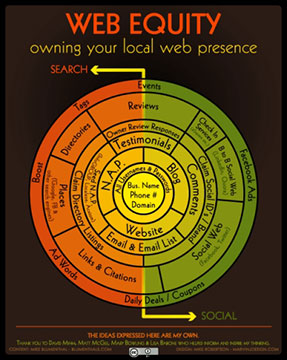
Core Marketing
Mike believes in building your core marketing first. He teaches small business owners, via GetListed Local University, to focus first on the marketing elements that you can control and then build from there. In other words, your marketing core begins with things like your business name, your phone number, your website and your blog. Build a strong foundation there and then move on to the social networks with a plan. His infographic helps you to see this concept.
I recently interviewed Mike and learned a few more things about him and this neat little tool. He feels that once we get the “big picture” of what our online marketing is for and should look like, it’s easier than we think. Mike is “a big believer that not only do small businesses need to understand the context of their marketing
Training for Online Marketing
“Reason and information are the currency of life,” Mike says. If he’s right, then we’d better start spending that money wisely. According to him, “each marketing effort should leverage what went on before.” I agree. And to help us (learn how to) leverage, we need a simple and systematic way to understand the overall strategy. Here are three tools from Mike’s world to help with this:
GetListed is a simple website that tests your business listing in the search engines. Why? Because it’s relevant to small businesses. These days, when we get ready to go somewhere, we pull out our smartphones and Google it. Or we map it out on our laptops and print it out before we leave the house. Or we let the GPS guide the way. The point is, we are using the Internet to find local businesses, and so are our customers. GetListed helps you figure out where your business stands and gives you advice on how to improve it.
GetListed Local University is live and in person training that focuses on smaller cities like Birmingham, Alabama and Spokane, Washington. It’s a half-day event that’s designed to give small business owners “up-to-the minute, pitch-free education about online marketing.” As an avid educator at the GetListed Local Universities, Mike believes that “Social engagement is important, but if potential clients can’t find a business at the moment they are ready to buy, then the business will be in trouble.” In other words, establish your website and get listed in the directories first. Social media (Facebook, Twitter, etc) come second.
Mike’s Infographic: Web Equity – Owning Your Local Web Presence is a single visual. Mike designed it to show “the marketing opportunities that are available to small businesses.”
I like this tool. It takes some thinking to digest it. But with his concise explanations and a little focus, the concept behind an effective online marketing strategy becomes clear. And for me, that’s a breath of fresh air.but they need to invest in their marketing in such a way that they are not giving away future equity without knowing it.”
What you don’t know about online marketing, about getting listed in directories, about the demise of the printed Yellow Pages, and the rise of online local searches (for everything from the closest restaurant to the nearest dry cleaner) can hurt you.
Family and Relationships
Arnold Schwarzenegger: as mistresses surface family takes a hit
May 13th, 2011/ Rita Watson
Love and Marriage Examiner

Despite declarations of love for Maria Shriver and hopes for reconciliation, the mistresses are beginning to surface. The Mirror pointed out today that Arnold Schwarzenegger 'mistress' denies causing marriage break-up. The article sounds a lot like those we read during the Tiger Woods mess. But there is one very big difference. When the disintegration of marriage is all over of the news, babies do not hear the gossip. In this case there are four grown children. And one child is front and center in a Tinseltown tidbit, but Gossip Cop assures us that Patrick is not dating Miley Cyrus.
As we have seen with all of the high profile infidelity cases with older children, gossip not only hampers reconciliation, but it strains the children. In this case the children are: Katherine Eunice born in 1989, Christina Maria Aurelia, born in 1991, Patrick, in 1993, and Christopher in 1997.
The headlines are blaring. The 2011 Pulitzer Prize winning Chicago Sun Times noted: “Sources close to the spouses say the collapse of the marriage was caused by multiple allegations of the aging action star’s marital infidelities. . .” Schwarzenegger infidelity allegations key to collapse of marriage ...
The Mirror said that there appeared to be a principle mistresses who shattered the marriage, but she claims she was just one of many.
Gigi Goyette’s allegations of a fling with Schwarzenegger – which he denies – are said to have distressed his wife Maria Shriver so much she’ll never take him back. Arnold Schwarzenegger 'mistress' denies causing marriage break-up
Many are rooting for reconciliation. Maria Shriver is a devoted Roman Catholic and for her, divorce would be a difficult option. The family attends Mass regularly. And it seems that as I reported earlier, there is hope. During this crisis, they may just pull together as a family.
The SF Weekly said yesterday that "the California Healthy Marriages Coalition, which receives $2.4 million annually in federal funding, is criticizing Schwarzenegger and Shriver for giving up after 25 years of marriage and announcing they will divorce." Pro-Marriage Group Wants Schwarzenegger and Shriver to Get Back Together.
Baby University? Better ways to raise smart, creative children
May 13th, 2011 / Alicia Bayer
Mankato Attachment Parenting Examiner
Last week I received an online ad that had me scowling indignantly at the computer. I don't usually even look at things like that, but this one caught my eye because it called itself "Baby University." I looked at the page and it was a certain popular manufacturer's toys that they claim you need to buy your infant to make him or her smarter, more creative, and all around more completely set for a brilliant life.
Fooey.
The ad listed toys in each of eight categories, all with bright colors and plastic parts you need to buy to give your child the "best." Oh yes, and you'll need batteries, since these all beep, flash and make lots and lots of noise.
No imagination required.
What follows is my take on much better ways to give your kids these opportunities in each of their categories....
Music Appreciation ~ Pots and pans, lullabies, clapping to music, nursery rhymes, being exposed to lots of kind of music, making jingle bell anklets and dancing in them, making shakers out of plastic bottles sealed tight with popcorn kernels or dried beans inside, dancing with mama to the oldies station, real instruments like flutes, tambourines and daddy's old guitar, drums made of oatmeal boxes, making up songs, attending cultural events and concerts (especially featuring music and dance from other countries), singing silly songs in the car....
Sensory Stimulation ~ Taking the time with babies to touch, smell and talk about everything you encounter, making smelling games with cotton balls soaked in scents like vanilla, stopping to touch brick walls and dandelion fluff on a walk, involving baby in daily activities with you by carrying her in a sling or carrier, giving him a pile of oatmeal to play with in the high chair, using scraps of ruined clothes to make up a book of textures like courderoy and satin, encouraging kids to taste a wide variety of foods, playing with water, snow, homemade dough, sand.....
Learning Fundamentals ~ Reading to your kids, talking to them, taking the time to answer the millions of why's you hear all day, singing the abc's, using colors and shapes in conversation ("Can you bring me the yellow box with the diamond on it honey? Ooh, look at the black and white kitty!"), pointing out letters and shapes encountered on signs and on walks, counting everything for fun....
Physical achievement ~ Walking with them, rolling balls, getting down on the floor and playing with baby, stacking blocks or boxes and knocking them over, tossing rolled up socks into a laundry basket....
Language development ~ Reading books, talking to your kids, describing what's going on to baby, using lots of new and varied words in conversation and taking the time to explain what they mean if asked, reading poetry, reciting nursery rhymes, life....
Architectural design ~ (It turns out this is their term for most of those toys with things to spin or push and I'm not sure I see the design element in those at all, so I'm offering up more real ones) Building with plastic or wooden blocks (get them by the ton at thrift shops), dropping poker chips into a slit cut in a yogurt container, sculpting homemade clay and letting it dry, making snow creations, playing in the sand, making mud pies and stone structures, using scraps of wood to sand and make your own building set, stacking measuring cups, matching tupperware containers with the right size and shape of lids, building forts and tunnels with empty boxes.....
Oceanography ~ (All right, I had to look here too and it turns out this is where they sell their fake fish bowls-- the answer to this one is obvious!) Real aquariums or fish bowls, a trip to an aquarium, reading brightly colored books about underwater life, visiting the ocean and exploring tidepools, making sponge fish for the bath....
Creative Expression ~ Life! Drawing pictures, using homemade play dough, making shapes with straws in a restaurant, playing dress up, making up songs and stories, making toys out of rocks and sticks and found objects -- and most importantly avoiding those annoying toys that blink and flash and gobble!
Here's to all those plastic things you never buy and the time you spent playing in the dirt with your children instead!
In the Mankato area, here's some fun places to take your little one for some of these experiences:
- The Children's Museum of Southern Minnesota has giant building blocks, on-site art materials and a huge variety of exhibits to interact with.
- Local parks like Minneopa Falls, Hiniker Pond and Sibley Park offer chances to play in nature, splash in water, get exercise and see wildlife.
- Thrift stores like the Salvation Army, MRCI and Again are great places to find blocks, wooden toys and other great goodies for children.
- Pet Expo has a wonderful walk-in aquarium that's lit by UV lights, perfect for some live oceanography fun!
Family and Relationships
What is in a friendship?
May 12th, 2011 / Sandi Todd
Milwaukee Friend Zone Examiner
What do you value in a relationship? Who do you see as a friend? Personally I see a friend as someone that not only tells me their fears and hopes but also listens to mine. I would want someone that talks about the future, not the past, I need positive interaction, not negative language, and I need a hand to hold not a finger pointed in my face.
What do you want your best friend to say to you first thing in the morning? I will take a “Hi! It is great to see you.” Why do I want to hear this, because I would say that to someone and expect the same. Not every day mind you, but it is always a good sign to be positive before you need to settle down to the everyday specifics.
Choose your friends wisely. Give and take is what it is all about. Don’t be too harsh though; lead the weak to be strong.
Advertisement
What does the Bible say?
Romans 14:10 you have no right to criticize your brother or look down on him. Remember, each of us will stand personally before the Judgment Seat of God.
Verse 17 for, after all, the important thing for us as Christians is not what we eat or drink but stirring up goodness and peace and joy from the Holy Spirit.
Romans 15:7 so, warmly welcome each other into the church, just as Christ has warmly welcomed you: then God will be glorified.
Technology
Let’s Get Small: HP’s Tiny WebOS Smartphone
Let’s Get Small: HP’s Tiny WebOS Smartphone
HP / Palm Veer - Mini Smartphone running webOS
The Veer is ridiculously small. Almost Zoolander ridiculously small.
When you first grip the thing in your hand and try out the keyboard, you think, “Oh man, this is never going to work.” But after a few initial typos, it’s actually not that bad at all.
At 3.25 inches long, the Veer is tiny, stealthy and unassuming. It’s so small, it’ll even fit in the coin pocket of your jeans. The back of the black model has a rubberized texture that keeps your brain from mistaking it for a large, smooth pebble.
The 2.6-inch touchscreen is minuscule compared to giant 4.3-inch stunners like that of the HTC ThunderBolt. But as long as you’re not dead set on streaming a lot of movies or TV onto your device, it’s just large enough to do most anything else.
The phone’s screen-sliding mechanism feels solid, but it is still easy enough to operate with one hand or one thumb. And although the super-small keyboard takes a bit of practice — and a lot of trust, because your thumb covers up half the keyboard — I was surprised at how often I was able to compose typo-free messages and e-mails on the raised keys.
Palm’s webOS really shines on a device with such a small form factor. Instead of the standard menu screens seen on other smartphones, webOS uses an array of cards that can be accessed with a single tap on the gesture pad, located right under the display. Opening a new instance of an application creates a new card. A swipe upward removes the card from the deck, otherwise it’s there waiting for you when you want to return to it. Related cards (like multiple Facebook pages, for example) stack on top of one another.
Unfortunately, the implementation suffers from a few unpleasant hiccups. Finger flicks need to be deliberate, or they won’t be registered by the device. While scrolling through the photo roll, images take a second to deblur. App loading occasionally stutters, and sometimes freezes — I found this particularly true when loading the web browser. Since games and apps functioned perfectly fine once opened, this seemed like more of a software issue than a problem with the Veer’s 800 MHz Snapdragon processor.
The HP Veer comes with a couple useful features baked in: integrated messaging and Just Type, which is standard to all webOS devices. Integrated messaging allows conversations with the same contact on different services, for instance, on Google Chat and SMS, to be synced up and displayed in the same timeline, providing a seamless record of your chats. And if you don’t feel like flipping through your cards or scrolling through your apps, you can use Just Type to begin typing an app name or search item, and the phone will bring it up for you.
The Veer can act as a Wi-Fi hotspot for up to five wireless devices on AT&T’s HSPA+ 4G network. It also takes decent photos with its 5-megapixel camera — as long as there’s not excessive sunlight, which made my shots look overexposed and washed out.
The HP Veer is a pretty great phone, despite its diminutive appearance. Wired’s first impressions of the device were spot on: This would make a great phone for a teenager or anyone who wants to stay connected, but doesn’t need a large, super-crisp display for video playback.
WIRED Fantastically small form factor fits comfortably in almost any pocket. Magsafe-style charger — why isn’t this standard on all phones yet?
TIRED If the box didn’t say 4G on it, I never would have guessed. Palm’s app store has a woefully dismal selection — only the biggest names are there. The battery is non-removable.
Religion and Spirituality
Islamophobia Watch
Documenting anti Muslim bigotry
The Freedom Sack: “a fundamentally criminal and oppressive Islamic tradition.”
by SHEIKYERMAMI on MAY 13, 2011
“Police Harassment”
In France, one month after the start of the nation’s burka ban, women wearing face-covering garments are being forced to remove their veil in public to avoid police harassment.
/images/burka.jpg
Oh the indignity! Imagine that: women being ‘forced’ to remove the freedom sack! If that doesn’t call for violent jihad I don’t know what does.
How the French veil ban is being implemented:
In France, one month after the start of the nation's burka ban, women wearing face-covering garments are being forced to remove their veil in public to avoid police harassment.
Five women were immediately detained by police for wearing the burka on city streets as they attempted to attend a conference on the effects of the law. The organizer of the conference was forcibly removed after he tried to talk to one of the women, who had become ill during questioning.
The conference was organized by the multicultural association Don't Touch My Constitution. The group has raised funds to help women pay the 150-euro fine the law calls for, but they say they haven't spent one cent.
Proponents of the law say the ban protects the country from religious radicalism, as well as France's principle of secularism, or laicite in French.
Many Muslims have complained that French media coverage consistently ignores the religious convictions of those who wear the burka. Instead, the women are portrayed as mere tools, with domineering men controlling their every move.
The law, which was roundly criticized by police organizations, may not have led to mass arrests, but Muslim groups say they must provide a voice for the many women who have refused to leave the house for fear of embarrassment.
People say the French government is applying the law carefully, but unevenly. It seems they're largely ignoring the heavily Muslim suburbs, but it also seems that police can still make a big show when they feel it's necessary.
Press TV, 11 May 2011
See also the New York Times which reports the French Interior Ministry as stating that police have stopped 46 women wearing face-veils in public, 27 of whom have been charged and will be fined about $215 or forced to take an official course on citizenship.
Bunglawussi Watch reports with glee:
“the police are largely ignoring the heavily Muslim suburbs”
Efforts to Ban the Burqa to Liberate Muslim Women

More Background On MostTalkedNews.com
MostTalkedNews.com was a wide-ranging digital news and content aggregation platform that operated primarily during the late 2000s and early 2010s. It reflected a specific moment in the evolution of online media—when independent publishers, niche blogs, and content networks flourished alongside traditional journalism. The site aimed to capture trending conversations across multiple domains, offering readers a centralized destination for what was “most talked about” across the internet.
Rather than functioning as a traditional newsroom with original investigative reporting, MostTalkedNews.com blended curated articles, syndicated content, and editorial-style blog posts. Its structure and tone were emblematic of early content aggregation strategies that prioritized breadth, accessibility, and search visibility over deep specialization.
Historical Context: The Rise of Aggregated News Platforms
To understand MostTalkedNews.com, it is important to situate it within the broader rise of digital publishing platforms in the late 2000s. This era saw the emergence of websites like HuffPost (formerly The Huffington Post) and BuzzFeed, which capitalized on viral content, aggregation, and shareability.
Simultaneously, the decline of print journalism and the growth of search engines—especially Google—created a new incentive structure. Websites began producing large volumes of keyword-optimized content designed to rank well in search results and attract organic traffic.
MostTalkedNews.com fits squarely within this ecosystem. Its emphasis on trending topics, broad categories, and easily digestible articles suggests a model designed to capture search traffic and casual readers rather than a niche or highly specialized audience.
Structure and Content Categories
One of the defining features of MostTalkedNews.com was its extensive categorization system. The site organized content into numerous sections, each representing a different area of interest. These included:
- Business and Finance
- Education
- Entertainment
- Family and Relationships
- Food and Restaurants
- Health and Fitness
- Home and Living
- Internet
- Jobs and Careers
- Politics
- Religion and Spirituality
- Science
- Society and Culture
- Sports and Recreation
- Technology
- Travel
This taxonomy mirrored the structure of large content farms and multi-topic blogs of the time. By covering such a wide array of subjects, the site aimed to appeal to a broad demographic and maximize its reach across different search queries and reader interests.
Editorial Style and Tone
The editorial voice of MostTalkedNews.com varied significantly depending on the article and category. Some pieces resembled straightforward news summaries, while others took on a more conversational or opinion-driven tone.
For example, business interviews—such as those featuring entrepreneurs and technology innovators—tended to adopt a more formal, structured format. These articles often included Q&A-style discussions, offering insights into industry trends, startup culture, and emerging technologies.
In contrast, sections like Family and Relationships or Entertainment leaned toward narrative storytelling, commentary, and lifestyle advice. Articles in these categories frequently discussed celebrity news, parenting strategies, or personal development topics, reflecting the blog-driven nature of the platform.
This mix of tones suggests that the site likely relied on multiple contributors or syndicated sources rather than a centralized editorial team with a uniform voice.
Content Examples and Thematic Diversity
A closer look at the site’s archived content reveals a striking diversity of topics:
- A business interview with a technology entrepreneur discussing the evolution of customer relationship management
- Articles on online marketing strategies for small businesses
- Commentary on celebrity relationships and public controversies
- Parenting advice emphasizing creativity and hands-on learning
- Technology reviews, such as early smartphones and mobile operating systems
- Discussions of cultural and religious issues, sometimes presented with strong opinions
This eclectic mix underscores the platform’s core identity: a general-interest site designed to capture attention across multiple domains rather than dominate a single niche.
Audience and User Experience
MostTalkedNews.com targeted a broad, general audience—essentially anyone interested in staying informed about trending topics. Its content was accessible, relatively short-form, and easy to navigate, making it appealing to casual readers rather than specialists.
The site’s layout, based on archived versions, followed a typical early-2010s blog format:
- A homepage featuring recent or “latest” articles
- Category-based navigation menus
- Individual article pages with minimal multimedia elements
- Calls to action encouraging users to subscribe to feeds or submit their own sites
This structure prioritized simplicity and functionality over visual sophistication. It also reflects the technological limitations and design trends of the time, when many independent sites relied on basic content management systems.
Submission Model and Community Aspect
An interesting feature of MostTalkedNews.com was its apparent openness to external contributions. The site invited users to submit their own news websites for inclusion, suggesting a semi-curated directory or network model.
This approach aligns with early web practices, where directories and link exchanges played a significant role in building traffic and authority. By allowing submissions, the platform could expand its content base while also fostering a sense of community among publishers.
However, this model also raises questions about editorial oversight and content quality. Without strict curation standards, such platforms often faced challenges related to consistency, credibility, and reliability.
SEO Strategy and Traffic Acquisition
MostTalkedNews.com appears to have been heavily influenced by search engine optimization (SEO) strategies common at the time. Key indicators include:
- Broad keyword targeting across multiple categories
- Frequent updates with new content
- Use of trending or attention-grabbing headlines
- Inclusion of both evergreen and timely topics
During this period, Google’s algorithms were less sophisticated than they are today, allowing content-heavy sites to rank well even without strong brand authority. However, subsequent updates—such as Google’s Panda algorithm introduced in 2011—began penalizing low-quality or thin content.
It is likely that changes in search engine algorithms contributed to the decline or eventual inactivity of sites like MostTalkedNews.com.
Popularity and Reach
While MostTalkedNews.com does not appear to have achieved the widespread recognition of major media outlets, it likely enjoyed moderate traffic during its active years. Its broad content strategy and SEO focus would have enabled it to attract visitors searching for specific topics.
However, the lack of strong branding, original reporting, or a distinct editorial voice may have limited its long-term growth and recognition.
Comparison to Contemporary Platforms
In many ways, MostTalkedNews.com can be seen as a precursor to modern content aggregation and curation platforms. However, there are key differences between it and today’s leading sites:
- Platforms like Reddit rely heavily on user-generated content and community moderation
- Sites like Medium emphasize individual authorship and long-form writing
- Modern news aggregators use advanced algorithms and personalization to tailor content to users
MostTalkedNews.com, by contrast, represents a more manual, static approach to aggregation, reflecting the technological and cultural context of its time.
Cultural and Social Significance
Although it may not be widely remembered today, MostTalkedNews.com offers valuable insights into the evolution of digital media. It illustrates how the internet democratized publishing, enabling smaller platforms to compete—at least temporarily—with established outlets.
The site also highlights the challenges of maintaining quality and credibility in an open, high-volume content environment. As readers became more discerning and search engines more selective, many similar platforms struggled to adapt.
Decline and Legacy
Like many early content aggregation sites, MostTalkedNews.com appears to have faded from prominence over time. Factors contributing to its decline likely include:
- Changes in search engine algorithms
- Increased competition from larger, better-funded platforms
- Shifts in user behavior toward social media and personalized content feeds
- Growing emphasis on high-quality, authoritative content
Despite its decline, the site serves as a snapshot of a pivotal era in online publishing. It reflects both the opportunities and limitations of early digital media strategies.
Final Assessment
MostTalkedNews.com was a product of its time—a broad, accessible, and SEO-driven news aggregation platform that sought to capture the pulse of online conversation. While it may not have achieved lasting prominence, it played a role in the broader ecosystem of digital content during a period of rapid transformation.
Its legacy lies in what it reveals about the evolution of online media: the shift from quantity to quality, from static aggregation to dynamic personalization, and from independent blogs to integrated content ecosystems.
For anyone studying the history of internet publishing, MostTalkedNews.com provides a useful case study in how early digital platforms operated, adapted, and ultimately struggled to sustain relevance in an ever-changing landscape.